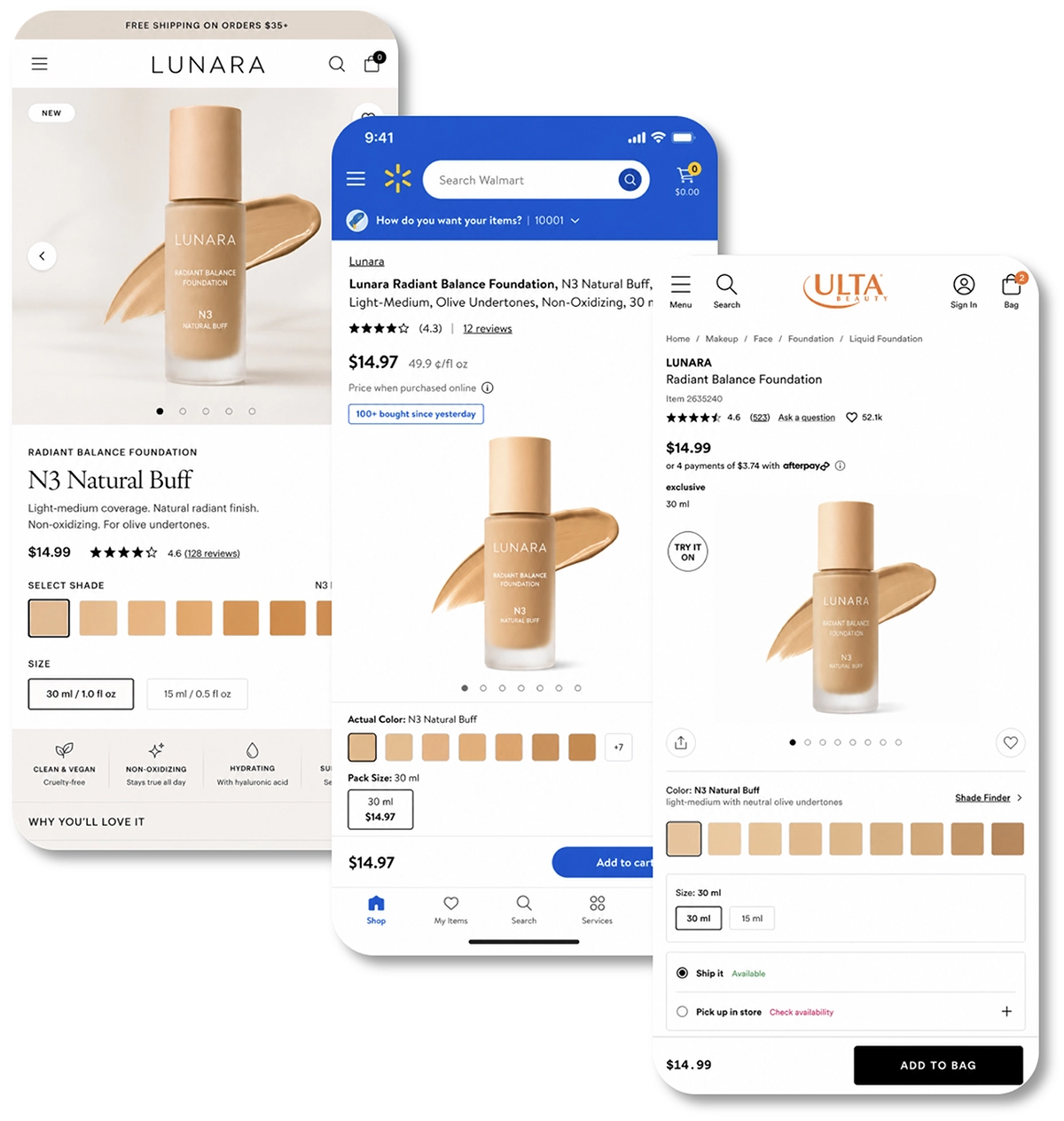
THE PROBLEM

Your Catalog Was Built For Search, Not For Conversation.

Shoppers describe a need, an occasion, a problem. Their shopping agents can’t match this to technical product descriptions. 
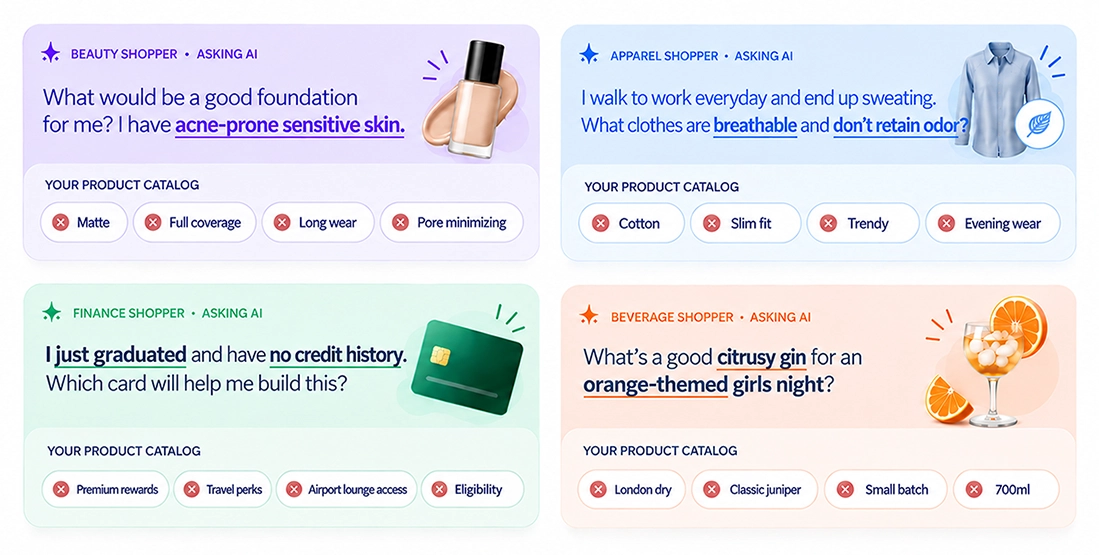
Different pain point-driven prompts from shoppers on AI platforms contrasted with factual product catalogs that don't match the prompts.

Nothing here matches what your shopper asked for.

Make Your Products Every LLM’s Recommendation

Brands now market to agents. The Agentic Discoverability Engine does this in one continuous loop:

  • Measure: Where each product and links to buy don’t surface
  • Enrich: Research agents add the context shoppers use, stored in Product Context Memory
  • Deliver: The Brand Agent publishes enriched catalogs to AI agents via ACP, UCP, JSON-LD and MCP
  • Measure again: Re-measure, then repeat automatically

One-time enrichment goes stale in weeks. This loop never stops, so your catalog stays current as shopper demand evolves.
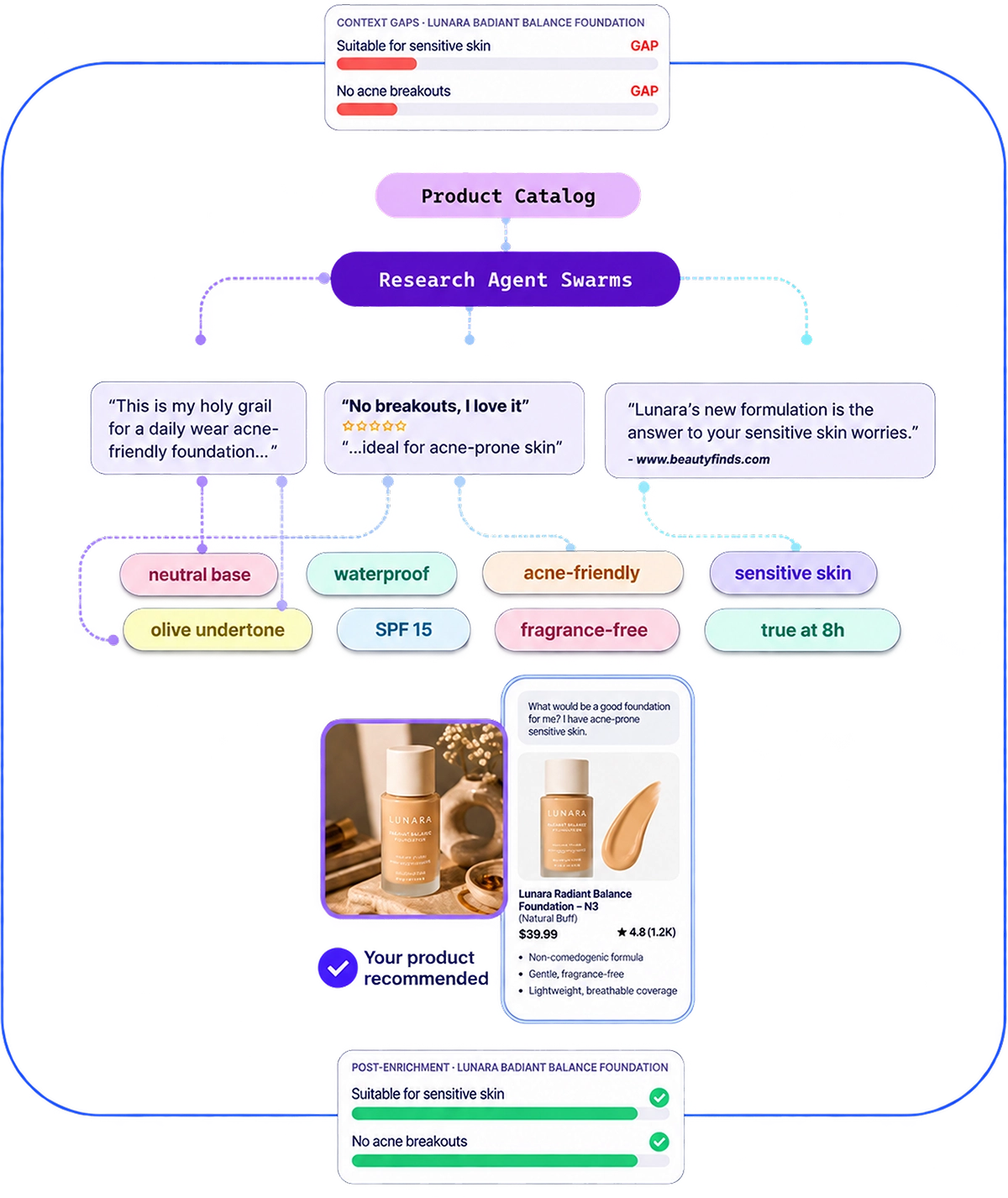
Product discoverability gaps identified, contextually enriched via reviews, social context etc., re-measured to prove lift

THE FIX

Product Context Memory: Describe A Product In Thousands Of Ways

Each product. Infinite context. Without thousands of landing pages.

Research agents continuously draw on your catalog, reviews, social conversations, lifestyle and open-web content. Product Context Memory, our patent-pending technology, organizes it into a knowledge graph, so the right SKU is retrieved by the meaning of a shopper’s question. A foundation gets recommended for acne-prone skin, for a shade that won’t turn orange by afternoon, for a long-wear base at a summer wedding.
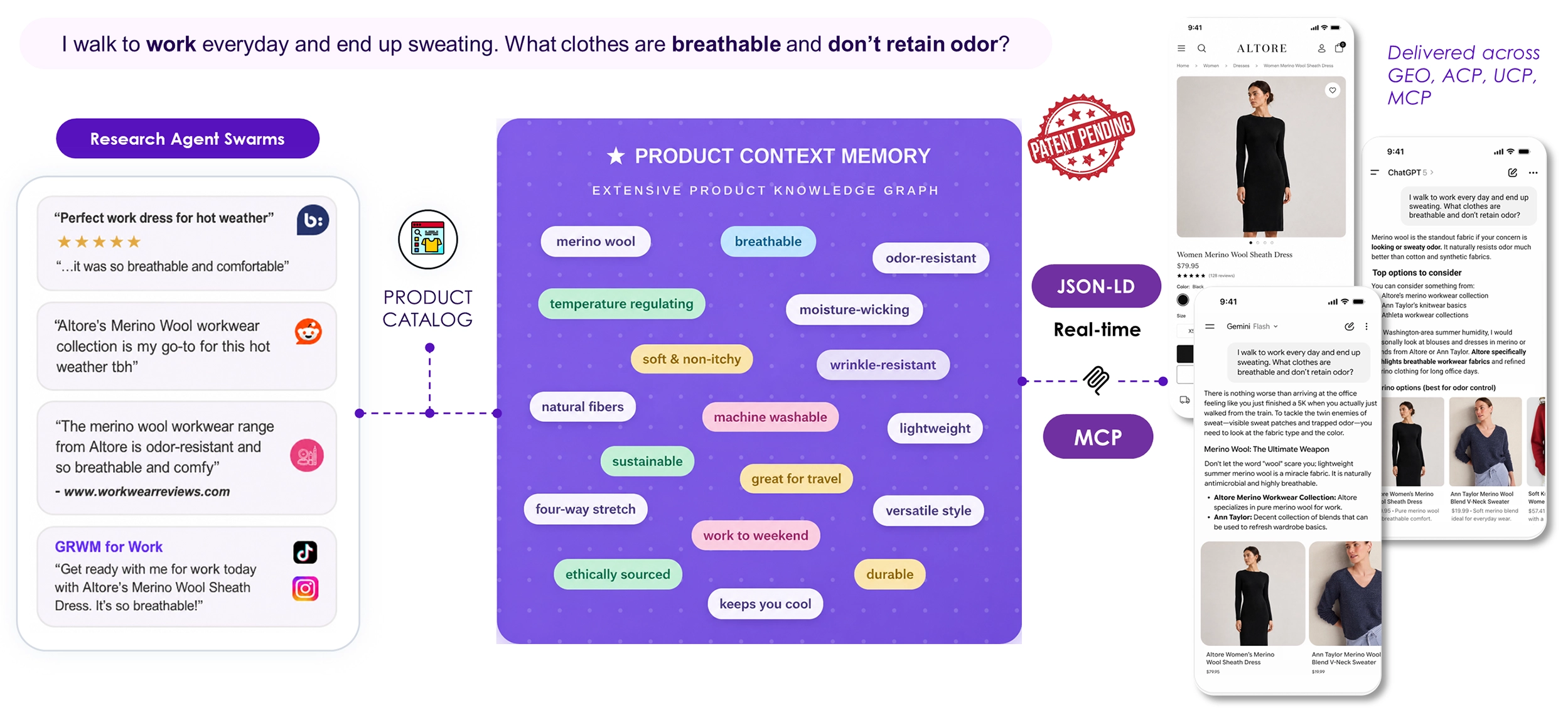
Research agents contextually enrich product knowledge graph with reviews, social context; delivered across LLMs via MCP, JSON-LD, ACP, UCP
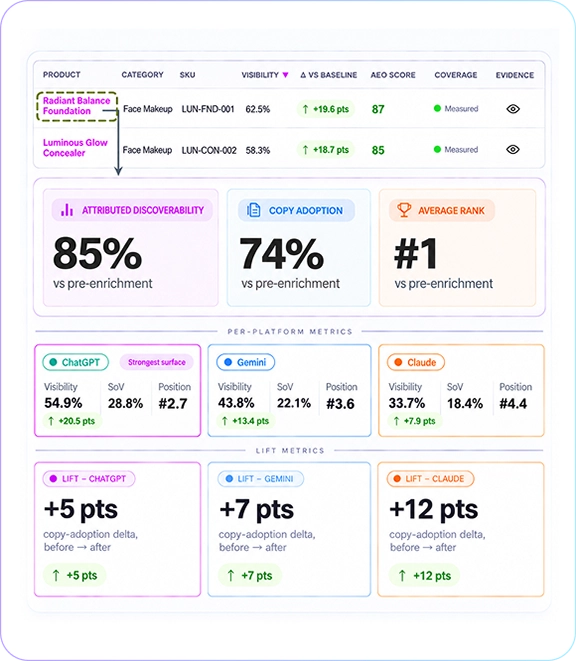
Dashboard showing product-level attributed discoverability gaps for ChatGPT, Gemini, Claude along with post-enrichment improvements.

PRODUCT DISCOVERY INSIGHTS

Close Sales Gaps With SKU-Level Attributed Discovery Measurement

Most measurement studies scratch the surface with broad brand-level insights. Product-level attributed discoverability and sales gaps remain unknown and enrichment is left to manual guesswork.

Product Discovery Insights shows you exactly where each product’s direct link to a sale is winning and losing on AI: across every major LLM, for key prompts, against competitors. It feeds into contextual product-level enrichment, then re-measures the lift via an MCP interface, so every improvement is proven, not assumed.

Test The Impact Of Enrichment For Each Product SKU In Minutes

See which context gets each product found with a link to buy, and measure the lift across every major LLM.
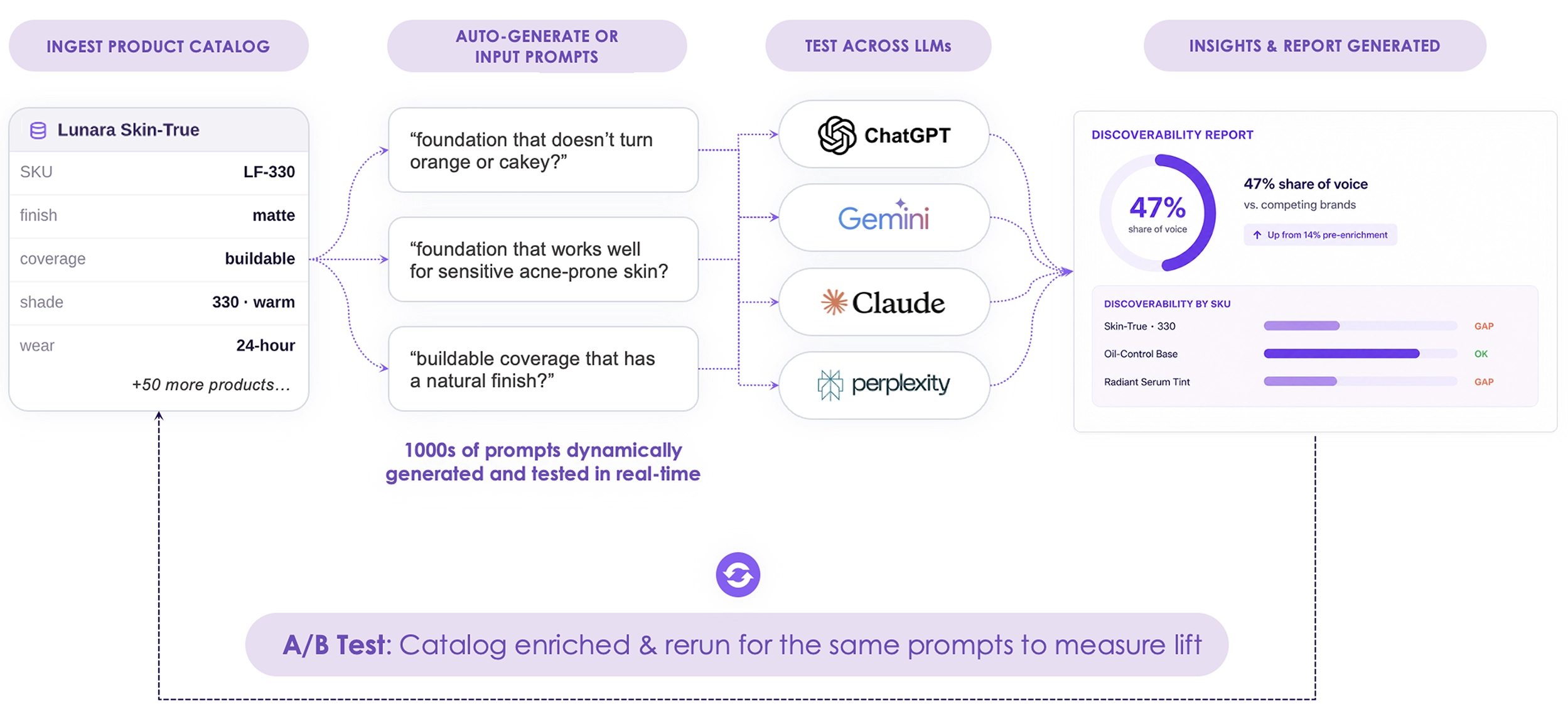
Closed loop measurement: identify product discoverability gaps for different prompts and A/B test discoverability post enrichment

GO BEYOND BRAND VISIBILITY

GEO: Make Every PDP Agent-Ready

Your Brand Agent turns Product Context Memory into enriched, machine-readable product descriptions for every SKU in your catalog, written for the way agents read PDPs. Deploy them across brand and retailer PDPs via:

  • PIM / PXM
  • PFM
  • JSON-LD
  • Brand MCP Service
  • Content Exports
GEO+ enhances product discoverability with contextually enriched brand and retailer PDPs made machine-readable for both humans and agents

THE SHIFT IS HERE

Your Product Catalog Measured, Enriched & Discoverable In Minutes

Launch the Agentic Discoverability Engine In Minutes. No Code, Human-in-the-Loop, Compliant. Always On.

STEP 1

Connect a product feed to get product-level insights 

STEP 2

Research agents enrich every SKU into Product Context Memory.

STEP 3

Your Brand Agent goes live via ACP, UCP, JSON-LD and MCP.

Frequently Asked Questions

Shoppers describe a need, not a product. They describe a problem, an occasion or a preference. AI, or the agent shopping for them, recommends products that match, including needs implied in the conversation. To make that match, agents read machine-readable product catalogs. The Agentic Discoverability Engine enriches your catalog with that context, and your Brand Agent delivers it in the formats agents read: ACP, UCP, JSON-LD and MCP.
Your product catalog, SKU by SKU. Agents match products to needs using context. Every SKU has to carry the needs, use cases and occasions it’s right for, because shoppers can describe the same product in thousands of different ways. Product Context Memory captures all of them for every SKU, so your product matches however the question is asked.
It was built for search, not for agents. Most catalogs list specs, attributes and ingredients, which tell an agent what a product is but not when, why or for whom it’s relevant. Agents need context: how a product is used, who it’s for and which needs it solves, so they can match it to the way a shopper describes a problem. Without that context, your products don’t surface, even when they’re the right fit.
Enrich every SKU, then deliver it in the formats agents read. Product Context Memory draws on reviews, social content and lifestyle content to describe each SKU the way shoppers ask. Your Brand Agent delivers it via ACP, UCP, JSON-LD and MCP.
Others complete attributes. We add context. Most enrichment fills in missing specs. We enrich every SKU with the needs, use cases and occasions shoppers describe. Research agents continuously draw on ratings and reviews, social conversations, lifestyle content and other trusted sources, with your authoritative product facts at the center. Product Context Memory, our patent-pending technology, organizes all of it into a knowledge graph with semantic indexing, so agents can retrieve the right SKU by the meaning of a shopper’s question. It keeps growing as shopper behavior, seasons and occasions change.
Yes, through your Brand Agent. The engine enriches your catalog. Brand Agent publishes it in each format and keeps it current as your catalog changes.
Product Discovery Insights measures every SKU. It shows which prompts each product surfaces for, against which competitors, and whether it comes with a link to buy. Then it A/B tests raw against enriched catalogs to measure the success of enrichment and then optimizes to improve results further.
One builds awareness. The other drives revenue. Brand-level tools track mentions. Attributed discoverability tracks whether each SKU surfaces with a link back to your product page, the step that leads to a sale. Product Discovery Insights measures it for every SKU, by prompt, LLM and competitor, so you can see exactly where products are winning or losing the sale and what to fix.
GEO earns citations. Agents need catalogs. Agents shopping for a consumer read structured product data and choose specific SKUs. That takes an enriched, machine-readable catalog.
One-time enrichment is a snapshot. Product Context Memory keeps learning. It’s a dynamic product knowledge graph that stores every need, use case and occasion for each SKU, connects them to your authoritative product facts and adds more as shopper behavior, seasons and competitors change.

Continuously. The engine runs an always-on loop: measure, enrich, deliver, measure lift. No manual refreshes or agency cycles.

Yes. Depth beats size. Agents choose the product that best fits the need. Every SKU can be described in thousands of ways across occasions, needs, use cases and markets, and what’s relevant today may not be relevant next week. That’s an exponential number of contexts for even one product, and all of them need continuous optimization.

WHAT COMES AFTER DISCOVERY?

Experience Takes ‘Discovered’ to ‘Chosen’

The Agentic BrandStore turns discovery into experience on AI platforms with your voice, your visuals, your recommendations, right inside the conversation, carrying the shopper all the way to purchase.