

Originally published on LinkedIn
Over the last several months there has been a lot written about Agentic Commerce and its impact on retail shopping. Consumer adoption of LLMs is growing in leaps and bounds. The most often cited number is 393% from Adobe’s Q1 US retail analysis. For some categories, like fashion and luxury, the growth is over 1000%. What is getting retailers and brands even more interested in Agentic Commerce is the significantly better conversions that AI traffic is bringing to retailers.
I have seen vastly mixed reactions to these statistics ranging from dismissal – saying the actual traffic numbers are still too low to worry about and that they will continue to prioritize search and other acquisition methods, to near panic that LLM traffic soon could be the primary source of traffic to retail sites.
The Numbers
The first question we should ask is what is so special about LLM traffic and why should brands and retailers invest more in growing LLM traffic? The answer also lies in that same Adobe report which cited that AI referred traffic converted 42% better than search referred traffic. Shopify reported 49% better conversion from AI traffic. I heard a retailer at Shoptalk in Barcelona say that AI referred traffic was the biggest impact factor in growing their profits due to very high conversion rates even though their AI sourced traffic right now was only 1%.
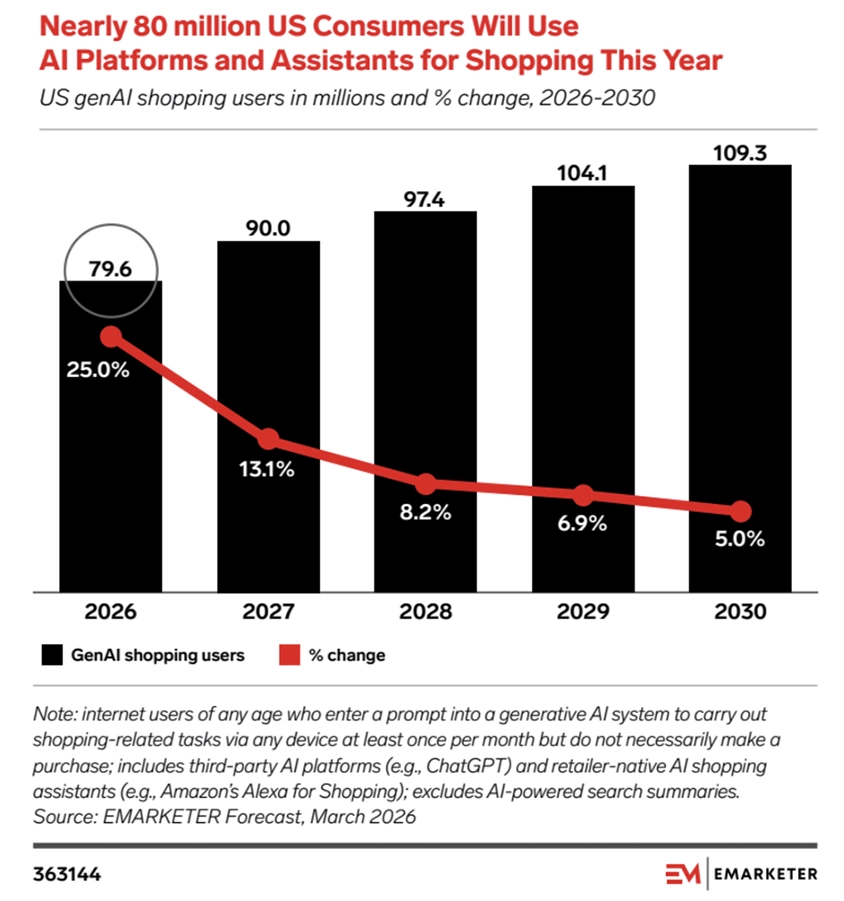
eMarketer report on AI Shopping
An Accenture 2025 Holiday Shopping Survey showed a glaring issue with retail eCommerce today — a staggering 85% of shoppers said they were likely to abandon their carts due to frustration or indecision (actual benchmarks show 70.2%, still, quite high). The reasons cited varied from too many product choices to the difficulty navigating and finding products using the “search-and-click” method that was developed over 20 years ago. That same survey pointed to something every brand and retailer should take note of as a call to action: 77% said they planned to use AI platforms for shopping citing ease of managing choices and increases in purchase confidence presumably as AI platforms help narrow down choices and answer questions in an easy and natural conversation that would otherwise take hours to answer on a retail website.
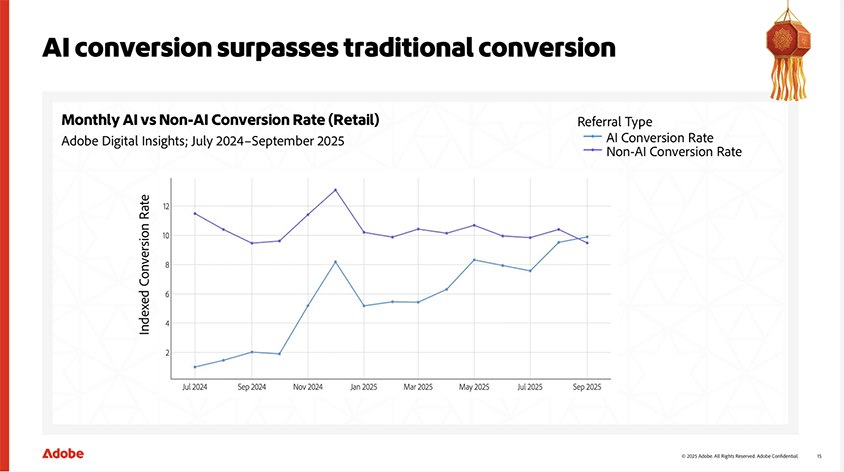
Adobe Analytics AI shopping trends in 2025
It is quite likely the reason AI sourced traffic is still in the low single digits for many retailers is because consumers are unable to find products in LLMs as easily as they can on search. Given an almost 50% improvement in conversions from AI platforms, investing in discoverability will pay off handsomely. For every 1% increase in traffic from LLMs, conversions will increase by almost 50% for that traffic. For a retailer with $100M in revenue that 1% of AI traffic represents $1M in GMV which if it increases by 50%, amounts to a $500,000 increase in GMV, so growing the 1% to 5% could deliver $2.5M in GMV growth.
What’s interesting is that investing in discoverability is also likely to also enable retailers and brands to gain marketshare if their competitor’s products are not discoverable. Nimble, first-mover brands and retailers could gain significant and permanent marketshare by ensuring their products are more discoverable. Brands and retailers therefore must ask themselves: what can I do to make my products more visible in LLM platforms?
Getting Products Discovered
LLMs have become more like advisors or even friends to many consumers, so unlike search where we often searched specifically for a product or a brand, in LLMs we are more likely to describe an occasion e.g. wedding, vacation etc., a condition e.g. happy, sad, a health condition etc. and hoping to find solutions. The challenge is, how does an LLM match a question like “I am going camping this weekend, it looks like it might drizzle a bit, what gear should I get” to a set of products from a brand or retailer that is the best fit.
Product catalogs and PDP pages of retailers were designed over 20 years ago when search was predominantly the way consumers found products and as a result product catalogs are filled with precise content designed to be matched by search engines where the consumer is asking a question like “I am looking for a Nike Pegasus sneaker in white, size 8”. What needs to be done to transform such catalogs into LLM and agent readable form is to enrich it or essentially redescribe it in terms that match how consumers ask for such products.
This requires finding such descriptions and enriching the content with such descriptions – many retailers and brands have resorted to hiring copy writers and agencies to address this gap, however that becomes a very expensive and time consuming undertaking with no way to verify whether the enrichments are working or not. LLMs find product content by crawling sites and are not obliged to crawl every site frequently and so such efforts may not pay off significantly. Besides, most tools which are used to measure discoverability aren’t very good at measuring discoverability at scale especially for large product catalogs at an individual SKU level. This activity, referred to as Generative Engine Optimization (GEO) can be a very time consuming and expensive endeavor with a low likelihood of success.
Advanced Enrichment And Discoverability Techniques
Automating enrichment requires first finding sources of content that contain the kinds of descriptions users would use to describe products, reviews, social platforms like Reddit, Youtube and others as well as reviews sites often are the best source for such content. This content however needs to be adapted, cleaned up (for brand safety) and matched up to products to ensure accurate descriptions that enhance and not diminish discoverability on LLMs.
This requires technology that is sophisticated enough to do this safely and at scale.
Once product catalogs have been enriched, they need to be published to LLM platforms. Here Gemini and OpenAI are offering some standardization in the form of ACP and UCP which essentially enable LLMs to ingest such enriched structured product content. ACP and UCP were primarily designed for commerce transactions and as such not ideal for enabling discoverability but is a good start compared to not being visible at all. Unfortunately ACP and UCP are only (as of now) available to retailers and merchants so for brands this is not a viable option. Another set of standards come from Schema.org in the form of JSON.LD which enables retailers to publish in JSON format on their websites, enriched product content that LLM crawlers can find and index. For brands the best bet for now is to send enriched descriptions to retailer PDP pages and hope for the best.
Hand in glove with such automated enrichment, there needs to be SKU level discoverability measurement which is currently lacking in most measurement products. This is critical to be able to show if such enrichment efforts are making individual products more or less discoverable.
The Future: Dynamic Product Intelligence
Current enrichment and discoverability techniques are at best static and limited in scale. Most products have hundreds of ways to be used and described and the current mechanisms are limited by their ability to manage a vast array of such product descriptions in a form that LLMs and agents can readily consume.
Basic enrichment needs to give way to true Product Intelligence which is an accumulation of all of the different ways in which a product and its attributes and use cases can be described in natural language friendly form.
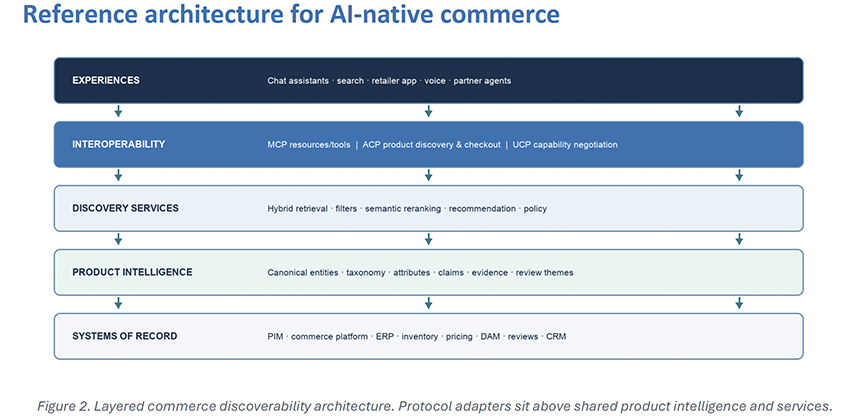
Product Intelligence: Critical to Agentic Commerce
For Agentic Commerce to successfully scale from its infancy now to become the dominant mechanism for consumers to find, engage with and purchase from brands via agents, discoverability needs to scale. Consumers are there already, brands and retailers need to get there quickly or risk losing significant marketshare as the whole ecosystem shifts to an agent powered commerce experience.