
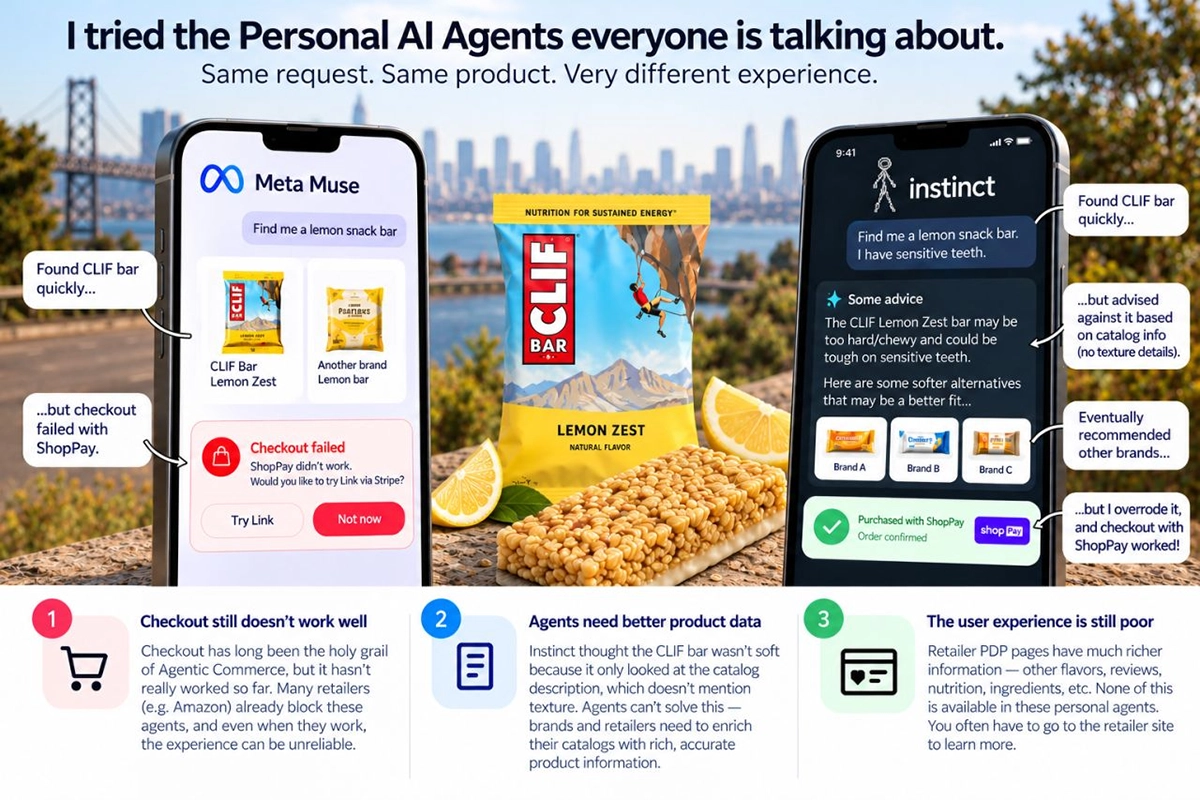
Lots of excitement (hype?) around Meta’s Muse, I saw 5 billboards driving yesterday and Instinct was the talk of the town in every social event. I decided over the weekend to take matters into my own hands and try them both. I decided to use lemon snack bars as a test case to see which one could find it quickly and help me buy.
I started by saying I was looking for a Lemon snack bar. Both quickly found the CLIF bar (and one other), I then tried to purchase, Muse failed with ShopPay and offered to try Link via Stripe, I didn’t want to give it my credit card (I already had ShopPay). I gave up and tried Instinct.
I decided to make it harder for Instinct. In addition to asking it to find me a Lemon snack bar, I made up a story and told Instinct “I have sensitive teeth” — Instinct decided to give me some advice , recommending I DON’T buy the CLIF Lemon Zest bar. It started giving me links to “causes of cracked teeth” annoying, as I didn’t ask for advice. It eventually did recommend some unknown Shopify brands. It turns out the CLIF Lemon Zest bar IS actually a soft chewy bar. I overrode its recommendation and it succeeded and quite impressively presented the ShopPay link and I was able to check out.
While these were not extensive tests by any means, they point out a challenges that such Personal AI Agents will face:
- Checkout has long been the holy grail of Agentic Commerce but has not really worked well so far — if I had tried the above with any store other that Shopify, I would not have been able to even get a far as I did – for example Amazon has already blocked both agents
- The reason Instinct concluded that the CLIF bar was not soft was it was looking at just the description in the catalog which doesn’t say anything about the texture of the bar. Consumer Agents cannot solve this, brands and retailers need to take this on.
- Even if checkout worked perfectly, in both cases the user experience was awful. Retailer PDP pages are challenging to navigate but do provide a lot more information e.g. other flavors available, reviews, nutritional values, ingredients etc. None of this is available in these personal agents – you have to go to the retailer site to learn more about the product
Some of this is expected with any new technology and there are solutions on the Horizon. Meta, Sierra, Shopify and others announced Personal Agent Protocol (PAP, yes, yet another acronym) which is aimed at making checkout and other commerce functions seamless across retailers. New platfoms and tools enrich catalogs for better discoverability and deliver immersive storefronts and great consumer experience via app-like interfaces.
At DaVinci Commerce we are 100% focused on these last two challenges and have deployed our platform successfully at some large global brands. We are solving the tough problems of product discoverability and consumer experience, both critical to successful Agentic Commerce.
